


Jewish representation in fantasy books and media, especially in high fantasy, doesn’t look like Judaism. At least, not at first glance. Even when it’s overt, some people don’t realize it. Heck, I gave my heavily Jewish-coded fantasy work-in-progress to a family with boys in the right age group for their opinion as beta readers and it completely went over their heads that there was anything Jewish about the persecuted nomadic outsiders boiling potato pancakes in oil (though they loved it!).
Jewish coding is not as easy as coding something as European fantasy, with castles and elves and wizard towers and medieval cottages. Everyone knows what that looks like without any elaboration. You can also recognize Asian-coded fantasy, such as Chinese-coding in books like Eon/Eona and the Japanese, Chinese, and Korean influence as well as Indian/South Asian and Indigenous Alaskan/Canadian tribal influence in shows like Avatar: The Last Air Bender. Children of Blood and Bone by Tomi Adeyemi is African-coded high fantasy you recognize at a glance. The second you see it, you know what it is.
What does existing Jewish coding in fantasy look like?
Well, traditionally, it looks something like… this:
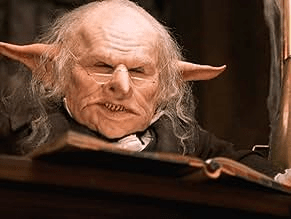
Long noses, child stealing, banking, greedy, short monstrous outsiders.
And Harry Potter isn’t the first to rely on negative Jewish stereotypes to strike fear into the hearts of children. It’s just one of the best known and more modern examples. Let’s go back further.
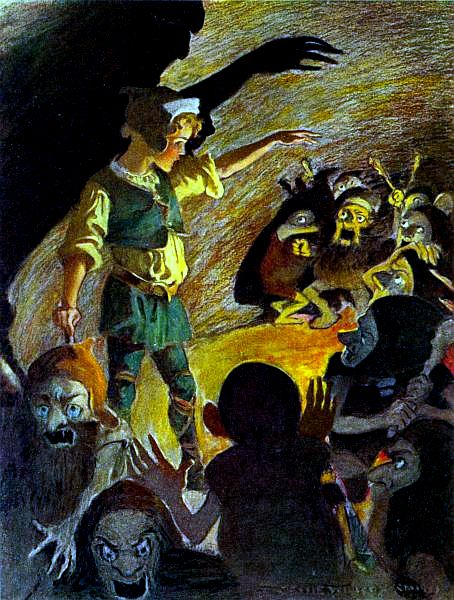
When I took a class on fantasy literature in college, one of the assigned books was a children’s fairytale book written in 1872 called The Princess and the Goblin by George MacDonald, a book that heavily influenced J. R. R. Tolkien and the goblins that appear in The Hobbit. MacDonald’s book, obviously, has goblins. The premise is that the mines near a young princess’s castle are inhabited by grotesque, evil goblins. These goblins used to live in the kingdom but were banished, and now seek their evil, evil revenge on the good, kind humans of the kingdom by kidnapping the 8-year-old princess to force her into a marriage with their goblin prince while planning to kill everyone else so they can take over. All I can say is… yikes. Child stealing is connected to the classic blood libel trope. Good, pure Christian girls being threatened with marriage to a barbaric monster is as classic “other” demonization as it gets and has been applied as justification to attack men from many minorities including African-Americans, Asians, Jews, and many others. I’m not even going to touch on the whole banished from their kingdom bit but suffice to say, it’s extremely antisemitic as portrayed in the book.
Here’s an illustration of the goblins, illustrated by Jessie Willcox Smith in 1920, illustrating a scene in Chapter 18 of the book in which a young boy fends them off with rhyming:
And the original drawings by illustrator Arthur Hughs depict the goblins like this:

I’ve heard some people claim that accusations of antisemitism in depictions like this are self hate. Why would I look at a greedy, ugly, short creature and see myself, after all? Obviously it’s not antisemitism because those aren’t Jews and I’m reading too far into this, seeing things that aren’t there, because the author isn’t explicitly calling their goblins Jews.
You don’t have to call something Jewish for it to be Jewish.
Aang the Airbender is not a Tibetan Buddhist monk, he’s an Air Nomad. Except he totally is a Tibetan Buddhist monk.
Trying to erase the connection between a literary creation and its origin is divorcing a text from its historical context and the influences that led to its creation. Nothing is ever created in a vacuum. You can’t tell me the difference between these goblins and Nazi era antisemitic propaganda. Beyond the medium used, there’s essentially no difference. That’s because, in a way, it’s all antisemitic propaganda, whether the authors claim it is or not.
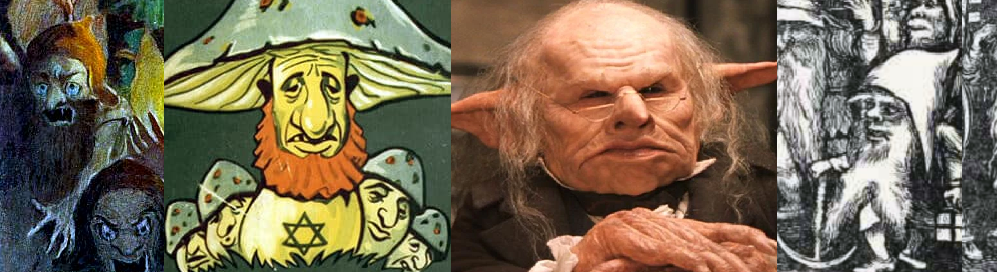
It’s a little ambiguous whether or not goblins started out as Jewish-coded fantasy creatures/folkloric creatures. I think the concept of creatures that would fall under the umbrella of “goblins” are not inherently antisemitic – kobolds, gnomes, pukwudgie, dokkaebi, and other creatures are sometimes called goblins or goblin-like despite sometimes having nothing to do with European goblins or being different in concept. That said, I think those creatures specifically called goblins are inherently antisemitic, and I have yet to see a depiction of anything called a goblin that wasn’t antisemitic in some way.
The word “goblin” is first recorded in the 14th century, but similar terms like “gobelin” and “gobelinus” can be found as far back as the 1100s to describe a demonic, mischievous creature. They became most notable in medieval stories and texts, which coincide with the rise of crusades starting in 1095, extreme hardships, blood libel accusations, expulsions, massacres, and other persecutions inflicted on Jewish communities by Europeans.
Regardless of where goblins originated and if that origin was inherently antisemitic, they at the very least became inherently antisemitic. The purpose of fairytales and folktales used to be to impart a lesson or give a warning to children. Don’t wander through the woods. Stay away from food you don’t recognize. Avoid danger that’ll pull you away from your family, your community, and the Church. Danger like those strangely dressed Middle Eastern outsiders who speak another language, don’t accept our version of god, that we blame for the death of our savior, and don’t look like us. Those people our leaders blame for missing children, plagues, and any tragedy they can reasonably or unreasonably pin as an excuse to blame someone other than themselves.
Is it a coincidence that stereotypical depictions of hags, witches, goblins, and all manner of evil child-snatching creatures from folklore have overly grotesque versions of stereotypically Jewish noses? That witches wear pointed hat not dissimilar to the Judenhut/Jewish hat that Jews were often required to wear to mark them as different from their Christian neighbors? These are all things developed especially in Medieval Christian Europe to indirectly warn children about Jews.
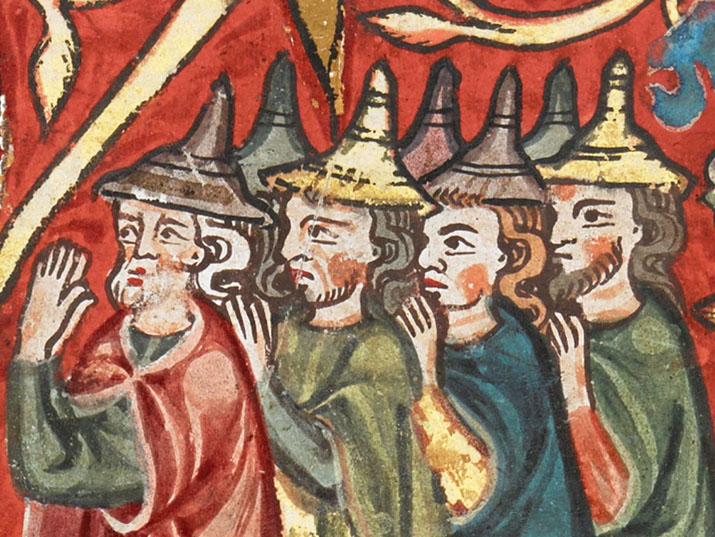
If you’re programmed from childhood to see mythical creatures with Jewish stereotypical traits as evil, then you’re programmed as an adult to see real, living Jews as evil.
And you’re ready to kill Jews for it.
Perhaps not yourself, but you’ll justify others who do it. You’ll call it self defense, you’ll call it a noble cause. You’ll claim The Jew is whatever the evil thing of the day is, simultaneously casting Jews as immigrants, ‘oriental’ brown foreigners, Christ killers, white colonizers, communists, socialists, and capitalists all at once, but it’s just programmed hatred so deep you’ll never root it out without intense introspection because you don’t even realize it’s there, you don’t recognize where it came from. Perhaps you won’t even recognize that it’s The Jew that you hate. You don’t hate Jews, just their beliefs, or just their culture. Just their politics. Just their society. Just their [insert excuse here]. And so you’ll justify painting all Jews with the same hate, ignore nuance, and accept violence that leads to burning hundreds of Jews to death in the Basel Massacre of 1349, or a 88-year-old Holocaust survivor with a Molotov cocktail so that she dies of her wounds in Boulder, Colorado in the year 2025.
Society continuing to perpetrate these prejudices and stereotypes is a serious problem. And perhaps it starts with kids at home reading innocent little fairytales about greedy, child-stealing, baby-eating goblins from parents who don’t see anything wrong and never have a conversation about the topic.
The fact is that goblins are antisemitic.
But, they’re also a staple of many fantasy worlds. Fantasy writers are constantly adapting and reimagining all sorts of creations, some of which have problematic roots. Is there a way to write goblins that isn’t antisemitic? I would say yes… and I’m working on my own reclaimed goblin-inclusive fantasy because I do believe in the importance of good Jewish-coded representation in fantasy, especially now that antisemitism has become so vile and pervasive. However, I’m not sure I’ve seen examples of goblins being handled in a way that avoids their antisemitic roots and I would like to analyze a few examples. When we know what went wrong, we can focus on how to do right.
The most famous goblins in media I can think of off the top of my head are Tolkien’s goblins in The Hobbit, J.K. Rowling’s banker goblins in Harry Potter, Dungeons and Dragons goblins, and World of Warcraft goblins. So, I think I’d like to do a series of blog posts analyzing all these goblins, what works and what doesn’t work in their depictions, and how they relate to negative Jewish stereotypes.
I think the worst of these and most aggressively antisemitic are the goblins in the world of Harry Potter (especially if you include the ones in Hogwarts Legacy), followed by Dungeons and Dragons, World of Warcraft, then the least harmful somehow being the oldest depiction with Tolkien due to the overall context of his work. I look forward to exploring these further in future posts and hope you’ll stay tuned!

Thank you for reading! Leave a like and a comment, and if you’re hungry you should check out the recipes on my cooking page!
Please note that I have no tolerance for antisemitic comments. If you are being antisemitic, I will block you. I owe you nothing and this is my space.
 amalenafolic.com
Leave a reply to Antisemitic Tropes: The Goblins of World of Warcraft Cancel reply